
EDA 57: Hans Winterberg: Chamber Music Vol. 3
IV: Hans Winterberg – Quintett für Klarinette und Streichquartett (1981/82)
Please select a title to play
IV: Hans Winterberg – Quintett für Klarinette und Streichquartett (1981/82)
Please select a title to play


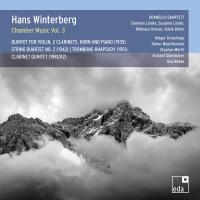 I: Hans Winterberg – Quintett für Violine, zwei Klarinetten, Horn und Klavier (1935)
1 Allegro grazioso
EDA 57: Hans Winterberg: Chamber Music Vol. 3
I: Hans Winterberg – Quintett für Violine, zwei Klarinetten, Horn und Klavier (1935)
1 Allegro grazioso
I: Hans Winterberg – Quintett für Violine, zwei Klarinetten, Horn und Klavier (1935)
1 Allegro grazioso
2 Andante
EDA 57: Hans Winterberg: Chamber Music Vol. 3
I: Hans Winterberg – Quintett für Violine, zwei Klarinetten, Horn und Klavier (1935)
2 Andante
I: Hans Winterberg – Quintett für Violine, zwei Klarinetten, Horn und Klavier (1935)
2 Andante
3 Allegro
EDA 57: Hans Winterberg: Chamber Music Vol. 3
I: Hans Winterberg – Quintett für Violine, zwei Klarinetten, Horn und Klavier (1935)
3 Allegro
II: Hans Winterberg – Streichquartett Nr. 2 (1942)I: Hans Winterberg – Quintett für Violine, zwei Klarinetten, Horn und Klavier (1935)
3 Allegro
4 Allegro molto moderato
EDA 57: Hans Winterberg: Chamber Music Vol. 3
II: Hans Winterberg – Streichquartett Nr. 2 (1942)
4 Allegro molto moderato
II: Hans Winterberg – Streichquartett Nr. 2 (1942)
4 Allegro molto moderato
5 Molto tranquillo
EDA 57: Hans Winterberg: Chamber Music Vol. 3
II: Hans Winterberg – Streichquartett Nr. 2 (1942)
5 Molto tranquillo
II: Hans Winterberg – Streichquartett Nr. 2 (1942)
5 Molto tranquillo
6 Tempo scherzando, poco moderato
EDA 57: Hans Winterberg: Chamber Music Vol. 3
II: Hans Winterberg – Streichquartett Nr. 2 (1942)
6 Tempo scherzando, poco moderato
II: Hans Winterberg – Streichquartett Nr. 2 (1942)
6 Tempo scherzando, poco moderato
7 Agitato moderato
EDA 57: Hans Winterberg: Chamber Music Vol. 3
II: Hans Winterberg – Streichquartett Nr. 2 (1942)
7 Agitato moderato
III: Hans Winterberg – Rhapsodie für Posaune und Klavier (1951)II: Hans Winterberg – Streichquartett Nr. 2 (1942)
7 Agitato moderato
8 Marcatissimo, non troppo allegro – Andantino – Allegro
EDA 57: Hans Winterberg: Chamber Music Vol. 3
III: Hans Winterberg – Rhapsodie für Posaune und Klavier (1951)
8 Marcatissimo, non troppo allegro – Andantino – Allegro
IV: Hans Winterberg – Quintett für Klarinette und Streichquartett (1981/82)III: Hans Winterberg – Rhapsodie für Posaune und Klavier (1951)
8 Marcatissimo, non troppo allegro – Andantino – Allegro
9 Allegro moderato
EDA 57: Hans Winterberg: Chamber Music Vol. 3
IV: Hans Winterberg – Quintett für Klarinette und Streichquartett (1981/82)
9 Allegro moderato
IV: Hans Winterberg – Quintett für Klarinette und Streichquartett (1981/82)
9 Allegro moderato
10 Andante sostenuto
EDA 57: Hans Winterberg: Chamber Music Vol. 3
IV: Hans Winterberg – Quintett für Klarinette und Streichquartett (1981/82)
10 Andante sostenuto
IV: Hans Winterberg – Quintett für Klarinette und Streichquartett (1981/82)
10 Andante sostenuto
11 Allegro animato
EDA 57: Hans Winterberg: Chamber Music Vol. 3
IV: Hans Winterberg – Quintett für Klarinette und Streichquartett (1981/82)
11 Allegro animato
IV: Hans Winterberg – Quintett für Klarinette und Streichquartett (1981/82)
11 Allegro animato
The four lives of Hans Winterberg
This third volume of our series dedicated to the chamber music oeuvre of Hans Winterberg is also a mirror of the inexhaustible inventiveness of this composer as well as the dramatic ups and downs of his biography and of the reception history of his works. Every composition presented on this CD as a premiere recording, or as in the case of the Second String Quartet as the first complete recording, confronts us with other questions and puzzles. Since during his lifetime Winterberg did not have any publishers to attend to the editing and distribution of his music, we mainly depended with regard to information about his works on documents in his estate (manuscripts, correspondence, press clippings) and in public archives. Of the four works presented here, the only one for which performances or radio broadcasts during the composer’s lifetime have been documented so far is the Second String Quartet. The Quintet, composed in Prague in 1935 and according to the current state of knowledge Winterberg’s first chamber music composition, is preserved not only in the form of copies of the score but also as an annotated set of parts, which may indicate a performance—or at least that the work was rehearsed. We know that Winterberg’s last chamber music work, the Clarinet Quintet—which he started work on in 1981 and completed in 1982—was written to be submitted to a composition competition organized by the East German Cultural Council. Since no parts have been preserved and there is no indication that the work was accepted for the competition or even won a prize, it is to be assumed that it was never before heard in public prior to the release of this CD. The same is true of the Trombone Rhapsody composed in 1951.
This situation is bewildering in as much as Winterberg was a quite sought-after composer in the years after his emigration to Germany in 1947. He established himself in Munich‘s musical life, where his performers also included musicians who until 1945 were part of the German-speaking population of Czechoslovakia, which had been annexed by Nazi Germany in 1938–39, and who were expelled after the end of the Second World War and found a new home primarily in Bavaria. Among them was Fritz Rieger, Winterberg’s fellow student at the German Academy in Prague, who became General Music Director of the City of Munich in 1950 and succeeded Hans Rosbaud as music director of the Munich Philharmonic. Performances of Winterberg’s piano concertos, symphonies, and symphonic works by the Munich Philharmonic were broadcast by Bavarian Radio (BR), and Winterberg’s presence at BR, for which he was active as a freelance employee, allowed him, in turn, to establish important contacts with the musicians of the BR Symphony Orchestra. Especially in the early 1950s, he did not compose for an uncertain future, as he had during the horrific war years, but rather for well-known performers. The situation is a different one when it comes to the compositions written in Prague before the war: after positions as répétiteur and conductor at the theaters in Gablonz and Brno, Winterberg stepped into the public sphere as a composer only around the mid-1930s. And this in the company of other composers born around the turn of the century—also including Viktor Ullmann—who were perceived as representatives of the German-Austrian-influenced part of the music scene of the still multilingual and multi-ethnic cultural life of Czechoslovakia. They organized collaborative concerts and were labeled in the press and on the radio—with the intention of building a kind of common bond —as “natives” and “young Praguers,” or in a terminologically reckless manner, as “Sudeten German composers.” Precisely in the works composed during this period, however, Winterberg emancipated himself from the dominating influence of the German-Austrian tradition in the succession of Wagner, Mahler, and Schoenberg—a tradition imparted to him by his teacher Zemlinsky—and attained a synthesis of artistic tendencies that was probably only possible in a former metropolis of the Austro-Hungarian Empire: the ultra-chromaticism of the Second Viennese School combined with the typical Janáček technique of polyrhythmic-ostinato treatment of small-structure thematic cells, seemingly folkloristic motifs in the context of a dissonant, radically contrapuntal texture that we in turn know from Bartók, a further composer highly regarded by Winterberg. At the same time, Winterberg’s expressive world is as diverse as his compositional approaches. Michael Haas pointed out the independence of the Czech avant-garde of the interwar period from contemporaneous trends in Berlin or Paris, as well as parallels between Winterberg’s style and the “magical realism” or “poetism” of the Devětsil movement in Prague and Brno.1
Quintet 1935
In Winterberg’s Quintet from 1935, composed for the unusual instrumentation of violin, two clarinets, horn, and piano, we encounter all the stylistic characteristics and formal strategies that would occupy the composer throughout his entire compositional life. It offers the perfect entry into his fantastic, original, and uniquely personal world of sound. The character of the three movements corresponds to a specific Winterberg typology: Initially, a rhapsodic, seemingly improvisational first movement; then a lyrical, narrative-like second movement; and, finally, a highly energetic, rhythmically distinctive third movement, often with folk-music-like reminiscences or (as a rule very sublimated) borrowings from jazz. A four-movement structure is rather seldom in Winterberg’s work; we will return to this in connection with his Second String Quartet. The opening of the Allegro grazioso presents us with a compendium of Winterberg’s compositional techniques in a nutshell: in the piano an initial rhythmic layer is established, a simple six-eight figuration; parallel triads convey the impression of a tonal center (E-flat Major). Against this, a rhythmically and harmonically contrasting second layer in 2/4 time is set in the winds and violin, in which the movement’s motivic-thematic material evolves out of an E Major/C-sharp Minor context. Winterberg’s compositional interest lies in the playing with these levels, their confrontation, and their reciprocal penetration, out of which result unconventional structural processes. In the questionnaire—already cited elsewhere2 — which Heinrich Simbriger sent in 1955 to composers from the regions of Central and Eastern Europe that had been populated by Germans until 1945, Winterberg pointed out the powerful influence of Schoenberg’s music, which made an impression on him like a “ghostly avalanche that destroys everything,” from which he however extracted what he could use for his “personal idiosyncrasy.” In the successive entries of the wind instruments at the beginning of the first movement, we find a beautiful example of Winterberg’s adaptation of Schoenberg’s concept of “Klangfarbenmelodie” (sound-color-melody). From these “color gradients” realized through the most subtle dynamic nuances sprouts melodic material which eventually attains concrete form in the violin: wide intervals that open the sound space upward, followed by chromatically falling lines into which direct allusions to the Tristan motif are woven: minor sixths upward, minor second steps downward. The second movement, Andante, seems like the accompaniment music to a pantomime in a mysterious, nocturnal scenario. Characters of the most diverse physiognomy —embodied by short, concise motives—interact in an abstract stage area before, following a moment of agitation, they join together in a dreamy, slow waltz. We remain in this fantastical world of an imaginary, surreal theater also in the third movement, the longest in Winterberg’s entire chamber music oeuvre. Eerie and bizarre is the ambience into which the composer literally lets us stumble—an effect that is created by the minimal shift of the measure accents of the two ostinato figurations rubbing against one another in the piano and clarinets. The instruments pass the motivic balls back and forth with virtuosity, making themselves independent from one another in constantly new polyrhythmic superimpositions and shifts—a wild chase culminating in a furious stretta, which ends not with a redeeming shot, but rather with an apocalyptic fusillade, echoing an eerie tritone of C–F-sharp in unfathomable depths.
The Quintet was found in a bundle of compositions which had survived the war and that Winterberg had deposited with his second wife, Adelheid Reinhardt, after his emigration to Munich. Why he did not take the manuscript with him after the separation from her in 1957; why he did not include the piece in his catalog of works, and not even mention it in the list of his lost works is baffling. Especially since, simply by virtue of its proportions—regardless of its compositional quality or genre-specific singularity— the Quintet numbers among his most significant chamber music works. That it could be returned to the musical world is due to Winterberg’s grandson, Peter Kreitmeir, who during his research repeatedly came across parts of Winterberg’s legacy that did not belong to the “official” estate, which after Winterberg’s death had been sold by his adopted son to the Sudeten German Music Institute in Regensburg.
Second String Quartet
Winterberg saw himself as a “bridge-builder”; in other words, he moved between all stools. And that not just as a composer. In 1930, he married Maria Maschat, a Sudeten German “Aryan” pianist and composer, which led to a break with his Jewish family. His father Rudolf, who owned a cloth factory in northern Bohemia with his brother-in-law, disinherited him.3 From this point on, Winterberg suffered constant financial hardship. On the other hand, his “mixed marriage” to an “ethnic German”—a status Maria Maschat acquired in 1939 following the annexation of what was known as the “rump Czech lands”—saved his life, since this afforded him protection under the rationale of Nazi racial laws, a protection his colleagues Ullmann, Haas, Krása, and Klein did not enjoy. They were deported to Theresienstadt already in 1942 and, in October 1944, from there to Auschwitz for elimination. Winterberg was banned from practicing an occupation, had to wear the Star of David, live in a “Jewish house,” and was subjected to forced labor. But he managed to get hold of music paper and, in spite of all adverse circumstances, to compose a small number of pieces that included some of his most important creations: the Second Piano Sonata, the Second Symphony, the Clarinet Suite and, in 1942, the year the Nazis murdered his mother, the Second String Quartet—extraordinary manifestos of human dignity and intellectual resistance against the German terror.
The history of this string quartet is as Kafkaesque as the composer’s entire destiny. The fact that it came into being at all, and that it was able to survive the war, is almost a miracle. It was given its world premiere during the period of Winterberg’s first major successes in Munich on 15 January 1951, in a studio production by Bavarian Radio with the legendary quartet formation led by Rudolf Koeckert, the concertmaster of the BR Symphony Orchestra—just fourteen days after the world premiere of Winterberg’s Second Piano Concerto with the Munich Philharmonic. Whether the work was ever performed in public during Winterberg’s lifetime is not known. Surprisingly, only the composer’s pencil manuscript has survived; no fair copy and also no parts. Inquiries to descendants of the quartet members were to no avail. This led to confusion, since the manuscript appears at first glance to consist of only three movements; the fourth movement was later found in a separate bundle of music and thus was not included in the first provisional edition of the work for the CD recording by the American Amernet Quartet. Therefore, parallel to the complete edition by Boosey & Hawkes, Winterberg’s Second String Quartet also experiences here a complete recording for the first time.
In contrast to the First String Quartet, which—like Winterberg’s First Symphony of 1935—with a three-part structure, foregoes a clear division into movements, and in contrast also to the two later three-movement quartets, the Second Quartet has a traditional four-movement structure, which likewise follows a dramaturgy passed on through the Classical and Romantic periods. Four-movement formats are found in Winterberg’s extensive body of work otherwise only in the Fourth and Fifth Piano Sonatas (EDA 54) and the Trio for Clarinet, Cello and Piano (EDA 53).
The first movement evolves from an extremely simple motivic cell—the ornamentation of the note b by its upper and lower leading tones—which is, however, immediately subjected to complex harmonic and rhythmic processes. The measure accents are obscured. The twelve-tone potential is already exhausted by the second measure. The continuous eighth-note motion creates a continuum of movement with the constant simultaneity of the overlapping of different and consistently antagonistic meters. This “metrical polyphony”—one of the most important trademarks of Winterberg’s style— compels us to utmost attention, but produces with practiced hearing an unheard-of aesthetic attraction. Even when in measure 49, clearly set apart by a caesura and a preceding transition, a second theme is introduced, the movement follows less the formal structure of the classical sonata form with exposition, development, and recapitulation than an extended song form. The middle sections process the initial alternating-note motif as well as its counterpoints and accompaniment figures according to the principle of the developing variation. A dramatic intensification is followed each time by a more tranquil section: first, a contrapuntal stretto of the original motif, then—the magical climax of the movement—a noema. The final section, quasi a coda, introduces new motivic material whose descending steps by thirds underscore the concluding gesture of the section and subtly foreshadow the mood of the second movement. The second movement is no less unconventional and likewise develops according to its own secret, inner logic. The entire first half is dedicated to a simple, folk-song-like melody, whose first phrase is made from the first five notes of the G-major scale, and which, at the beginning, performs a bitonal balancing act—as if on a silken thread—over the pedal note B-flat in the viola. Material that is derived from this melody forms the basis for two further variation-like sections, which are framed by a short prelude, interlude, and postlude. The gentle melancholy of this far-flung first section is now less contrasted, but intensified by the following B section: once again, a simple diatonic melody reminiscent of a children’s song or the phrase of a counting rhyme in the viola and in a dreamy B minor of hardly to be endured wistfulness grounded by a play of light and shadow in the accompaniment shifting between A major and A minor in the second violin and cello. A short reprise of the A section concludes the movement. With the following scherzo, we return gradually from the world of dreams into life, but Winterberg leads us onto thin ice, for there are no certainties here. The opening “Tempo scherzando”—a waltz—is anything but cheerful and, as if it were a homage to Berlioz’s dark humor, a funeral march—Poco più tranquillo (quasi marcia funebre)—follows as the middle section in place of a trio. Highly emotional then is the reprise of the scherzo, which like hardly any other music by Winterberg reminds us with its ostinato patterns so directly and instantaneously of Janáček’s incantations. The falling gesture, introduced at the end of the first movement with thirds and intensified at the end of the second movement by fifths and sixths, becomes here, at the end of the third movement, a dramatic incantation that is surpassed in expressiveness only by the falling sevenths at the climax of the last movement. The excitement that Winterberg gradually builds up over the first three movements literally discharges in this rondo, the most virtuosic, complex, and longest movement of the piece: 365 measures—as if each measure stands for one day of a year brimming with conflicting emotions, fear, and hope. Again, the economy with which Winterberg develops large structures out of the smallest motivic or rhythmic cells is astonishing. A chromatic sixteenth-note figure—“f–e-flat–e–f”—in the second violin forms the nucleus. Together with a dotted motif in the cello, it establishes the 2/4 meter on the basis of which evolves a fascinating play of polyrhythmic counterpoints. In the further course, this cell appears in ever new diastematic and rhythmic variations, at the emotional climaxes of the ritornellos with piercing intensity, then augmented and elongated into a triplet. At the end of the movement, after a furious stretta, Winterberg lets it have the final say; as if gasping for breath, it starts again twice to then quasi freeze within itself in a dissonant tetrad.
Rhapsody for Trombone and Piano
The works that came into being in the early 1950s show us a different Winterberg. Above all Fritz Rieger’s engagement in Munich opened for the now fifty-year-old the first chance for a real breakthrough, the performances of his works were successful, and his name began to establish itself in the press. His network of contacts in Munich’s music scene grew rapidly, and above all the radio with its broadcasts helped ensure sustainability. All of this explains the optimism, the élan vital, and—as with Hindemith—the interest in instrument-specific effects in the works that were written in quick succession in 1950 and 1951. At no other moment of his life was Winterberg so creative, and at no other did he compose so directly for the present day, for specific musicians, and for specific occasions. And yet, questions remain. Why was the Trombone Rhapsody, completed on 6 November 1951 in Riederau am Ammersee, never performed? The repertoire for trombone and piano at this time was still sparse, and one did not write for this combination without a specific reason. On the end paper of the manuscript is found a crossed-out dedication to Agi Brand-Setterl, the Munich pianist who, together with trumpeter Willy Brem, had premiered Winterberg’s First Trumpet Suite on 2 March 1950, in Munich’s Amerikahaus. It is quite possible that one of Brehm’s brass colleagues was in the audience and approached Winterberg after the concert to ask for a new piece. Agi Brand-Setterl then played the world premiere of Winterberg’s First Piano Concerto on 13 November 1950, with the Munich Philharmonic under the direction of Fritz Rieger. The Munich press wrote enthusiastically about the work, but criticized her performance as “at times lackluster” and “impersonal” (Süddeutsche Zeitung, 17 November 1950). Did Winterberg, who was apparently not an easy-going person, say something in the same vein? Was there a falling-out? It is uncertain whether Winterberg knew the Trombone Sonata that Hindemith composed in 1941. In any case, he made no secret of his esteem for Hindemith, who was still living in American exile in the early 1950s. Striking are the parallel ideas with regard to the balance of the tonal spectra of the two instruments: the “full,” chordal texture and rhythmically prominent piano writing as a counterbalance to the voluminous trombone sound, for example, or the contrast between the trombone as the leading melodic instrument and the high-register piano figurations. Interestingly, Winterberg completely dispensed with any polyrhythmic complexities. With its clearly structured three-movement form, the work is, in terms of its syntax, rather a sonatina, but with its technical demands and interpretative challenges, it is in every way on a par with Hindemith’s Sonata.
Clarinet Quintet
This last chamber music work by the meanwhile eighty-year-old composer—and one of his last compositions altogether, was composed during an entirely different life and creative phase—it was followed in 1984/85 only by three piano pieces. It is a milder, more mellow swan song that foregoes all display of virtuosity. The clarinet’s solo role in all three movements is never contested, but it can neither shine nor show off with technical finesse and unusual playing techniques, as in Winterberg’s Clarinet Suite. Finesse, on the other hand, can be found—above all in the two outer movements—again in Winterberg’s playing with rhythm and meter. Already in the cello’s three “curtain” measures, it is uncertain whether they want to be heard in 3/4 time (waltz) or 6/8 time (barcarolle). The remaining strings enter with a simple scale motif that initially assumes a hemiola character but then, in an imitative exchange with the clarinet, apparently wants to set a 5/4 meter. Certainty about an unambiguous meter organization is found only starting in m. 18, where a 3/4 meter is able to establish itself in which the actual theme or the compositional “main objective” is presented: the “conflict” between binary and ternary meter, which is successively resolved in favor of the latter. Only through this “dialectical” process does the formal structure of the movement— enigmatic at first glance—become understandable or, respectively, answer the question regarding the final section, which after all makes up a good quarter of the movement and has neither with the character nor thematically anything to do with the preceding: its 9/8 meter is the logical consequence of the replacement of a triplet feeling (3 against 2 eighth notes in a 3/4 meter) with the triplet eighth note as the now perceived smallest basic rhythmic unit. It owes itself, so to speak, to the perceived formally necessary consolidation of this process, which Winterberg concludes with an elegiac and likewise tongue-in-cheek reminiscence of the beginning. The middle, slow movement presents itself as a simple three-part song form, featuring a cantabile A section (and its repetition) in which the strings lay out a moving tapestry of sound for a freely sung-out clarinet cantilena, and a more rhythmically prominent, interactive middle section. With the last movement, Winterberg treats us to a light-hearted finale; the polyrhythmic interplay revolves here entirely around the simultaneity of a triple meter and hemiola groups of two and four. Astonishing is the stretta, which catapults us almost a half a century back into the almost verbatim quoted end of the Quintet from 1935. It is unlikely that Winterberg, who apparently no longer had an idea of the existence of this work, wanted to forge a conscious bridge to his early days; more probable are the unfathomable workings of the unconscious, which felt that time had come for a conclusion.
Winterberg's hopes for an international career had come to naught. He had not succeeded in getting his foot in the door of the Bavarian Radio’s musica viva series. As a spectator of the new music scene, he followed the avant-garde’s attempts to get out of the dead end into which serialism had led it, the liberating breakthrough of postmodernism, and the alternative paths of American minimalism. He did not participate in any of these -isms. As a young man, he made prolific use of Schoenberg’s achievements; his music is bountiful in minimalist explorations thanks to Janáček’s legacy. Today, where it has finally been made accessible after a deep sleep, we can approach it without the zeitgeisty prejudices and blinders of our own era, and with a broader knowledge of the developments during the first half of the twentieth century in Central Europe, we can also better understand the traditions from which it drew upon. And one would do well to train one’s ear on it. One can only agree with the verdict by the critic of the Münchner Merkur, who wrote on 24 July 1962, following a radio broadcast of Winterberg’s Second Symphony: “It is modern music, but it is not inaccessible. It is comprehensible and reveals its depth after repeated listenings … It is music that grips the concentrated listener in a way we do not often experience with modern compositions.”
Frank Harders-Wuthenow
Translation: Howard Weiner
_______________________
[1] See Michael Haas‘s, preface to the first edition of the Quintet from 1935, Boosey & Hawkes 2025
[2] See also the booklets for EDA 51, 53 and 54.
[3] This is evident from a letter written by Maria Maschat on 28 September 1939 to the “Deputy of the Führer” in Munich – that is, to Rudolf Hess’s office – in which she asks for her husband to be exempted from the regulations of the Nuremberg Laws because of the precarious economic circumstances in which the family found itself.