
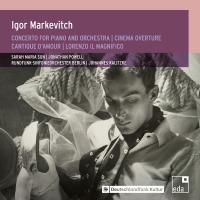
EDA 56: Igor Markevitch: Concerto for Piano and Orchestra / Cinema Ouverture / Cantique d’Amour / Lorenzo il Magnifico
IV: Igor Markevitch – Lorenzo il Magnifico (1940)
Please select a title to play
IV: Igor Markevitch – Lorenzo il Magnifico (1940)
Please select a title to play


EDA 56: Igor Markevitch: Concerto for Piano and Orchestra / Cinema Ouverture / Cantique d’Amour / Lorenzo il Magnifico
 I: Igor Markevitch – Concerto for Piano and Orchestra (1929)
01 Allegro vivace
EDA 56: Igor Markevitch: Concerto for Piano and Orchestra / Cinema Ouverture / Cantique d’Amour / Lorenzo il Magnifico
I: Igor Markevitch – Concerto for Piano and Orchestra (1929)
01 Allegro vivace
II: Igor Markevitch – Cinema Overture (1931)I: Igor Markevitch – Concerto for Piano and Orchestra (1929)
01 Allegro vivace
04 Cinema Ouverture
EDA 56: Igor Markevitch: Concerto for Piano and Orchestra / Cinema Ouverture / Cantique d’Amour / Lorenzo il Magnifico
II: Igor Markevitch – Cinema Overture (1931)
04 Cinema Ouverture
III: Igor Markevitch – Cantique d’Amour (1936)II: Igor Markevitch – Cinema Overture (1931)
04 Cinema Ouverture
05 Cantique d’Amour
EDA 56: Igor Markevitch: Concerto for Piano and Orchestra / Cinema Ouverture / Cantique d’Amour / Lorenzo il Magnifico
III: Igor Markevitch – Cantique d’Amour (1936)
05 Cantique d’Amour
IV: Igor Markevitch – Lorenzo il Magnifico (1940)III: Igor Markevitch – Cantique d’Amour (1936)
05 Cantique d’Amour
06 Allegro con brio ma sempre maestoso
EDA 56: Igor Markevitch: Concerto for Piano and Orchestra / Cinema Ouverture / Cantique d’Amour / Lorenzo il Magnifico
IV: Igor Markevitch – Lorenzo il Magnifico (1940)
06 Allegro con brio ma sempre maestoso
IV: Igor Markevitch – Lorenzo il Magnifico (1940)
06 Allegro con brio ma sempre maestoso
08 Andante con moto
EDA 56: Igor Markevitch: Concerto for Piano and Orchestra / Cinema Ouverture / Cantique d’Amour / Lorenzo il Magnifico
IV: Igor Markevitch – Lorenzo il Magnifico (1940)
08 Andante con moto
IV: Igor Markevitch – Lorenzo il Magnifico (1940)
08 Andante con moto
10 Finale
EDA 56: Igor Markevitch: Concerto for Piano and Orchestra / Cinema Ouverture / Cantique d’Amour / Lorenzo il Magnifico
IV: Igor Markevitch – Lorenzo il Magnifico (1940)
10 Finale
IV: Igor Markevitch – Lorenzo il Magnifico (1940)
10 Finale
The life and work of Igor Markevitch, this luminary figure of the music of the twentieth century, is well documented – and yet it confronts us with a series of questions and riddles. The biggest was undoubtedly his decision, after a career of merely fifteen years as a composer, which began with a meteoric rise and in which he was regarded as a kind of successor to Stravinsky’s throne, only to give up composing entirely and devote himself to conducting, pedagogical functions and, ultimately, to writing and editorial work. The reasons cited for this decision were: a serious health crisis in 1942, the increasing aversion to the dependence on patrons and sponsors, the rupture of civilization of the Second World War during which he joined the Italian Resistenza, or the vehement rejection of his orchestral work Le nouvel âge by French audiences and the Parisian press in 1938. Possibly all of this may have worked together. However, I believe the answer lies primarily in Markevitch’s occupation with the story of Icarus, to which he dedicated one of his major works and which was the focus of his attention for a long period of time. He interpreted it ambivalently, on the one hand, in the sense of Goethe’s idea of metamorphosis, that is to say, the completion of one developmental stage that leads to the beginning of a new, higher stage; on the other hand, in the sense of progress that leads to catastrophe, which Markevitch aptly summarized in the expression "arriving burnt." Markevitch was aware that, as a composer, he had experienced a process of development in which at an early phase in his life he had attained an extraordinarily high level of perfection. This process can be clearly comprehended through attentive listening to the present recordings. He may have considered this process complete – at least temporarily – at a point in time when his "outer" life was experiencing dramatic cuts and when he realized that, even as a re-creative artist, he was able to serve his highest goal, namely to make the spiritual in the music accessible. The many-sidedness of the Renaissance man – prototypically seen and admired in the figure of Lorenzo de’ Medici – may have served as a model for him.
The radicalism and perfection of Markevitch’s compositions, the unfamiliarity of his musical language, had – above all against the background of his youthful age – a shocking effect on his contemporaries. In 1936, Jacques Ibert used the today entirely hackneyed superlative of the "exceptional figure"1 and spoke of music that "baffles" one, while composer and critic Henri Sauguet acknowledged Markevich’s "exceptional position" among contemporary composers. Cocteau, who penned the text for Markevitch’s Cantata, described his listening experience as "a dreadful trepidation that made us feel lonely in the middle of the audience and that announced to us the arrival of the angel of the new." I myself experienced this "shock" that Markevitch’s music was able to trigger back then, and is still capable of today, in 2012 on the occasion of a concert in Montreux in honor of his 100th birthday. Jean-François Monnard, deputy director of the Septembre Musical Festival, had suggested the Cantique d’Amour for the guest appearance of the Royal Philharmonic Orchestra, and I will never forget the mixture of excitement, irritation, and bliss that this performance, under the direction of Charles Dutoit, unleashed in me. It was an ecstatic experience. But of a different kind than that which we can experience in Wagner, Scriabin, Schreker, or Ravel. Something superhuman, supernatural plays a role here, something that is difficult to put into words, but for which one can at least find an analyzable equivalent on the level of the "material" in the "ethereal" instrumentation of broad passages of this score.
Markevitch undoubtedly numbers among the most influential conductors of the twentieth century – the triumph of Stravinsky's Sacre on concert stages around the world was due to him as well as to Ernest Ansermet – but as a composer, he is virtually non-existent in today's concert life. He shares this fate with many "stateless" composers who in the political turmoil and catastrophes of the twentieth century were condemned to a plurinational existence – Darius Milhaud put it in a nutshell with his dictum about the "young Russian without connection to his country" – which, with the prevalent program dramaturgy of orchestras and concert halls that primarily draw from well-stocked national repertoires, is a real shortcoming. To the present day, aside from the complete recording released on Naxos in the 1990s by the Arnhem Orchestra, there has been no other CD production of a work by Markevitch, and not a single world-class orchestra that he directed or built up as chief conductor has yet undertaken one of his scores. That is why I am very happy about the realization of this recording with the Berlin Radio Symphony Orchestra conducted by Johannes Kalitzke, and featuring the wonderful soloists Sarah Maria Sun and Jonathan Powell. They present four works that show Markevitch from his most captivating side and will hopefully provide an impetus for further occupation with him. I would like to commemorate David Drews, the visionary musicologist and publisher who in the late 1970s brought Markevitch's scattered oeuvre en bloc to Boosey & Hawkes. Thanks also to HK Gruber, the friend who for many years worked to promote Markevitch and who suggested the production, Stefan Lang, who got it off the ground, Dr. Christine Anderson, who supervised it, and, last but not least, Jean-François Monnard, who wrote the following commentary text exclusively for this booklet and to whom we owe the magnificent exhibition, documented in a catalog, on Markevitch’s life and work, which he curated in Chillon Castle in 2012
____________________
[1] This and all following quotes are taken from the book Igor Markevitch, Musik der Zeit, vol. 1, edited by Josef Heinzelmann, Bonn 1982.
Frank-Harders-Wuthenow
For a long time Markevitch resolutely eschewed any emotional elements in his music, focusing only on the sonic material which generates movement and rhythm. The musician was accordingly criticised for an intellectualism that excluded all sentiment. It was only towards the end of his compositional career that genuine expressive concerns began to emerge. These can be seen as the result of a long process of inner renewal, for which Lorenzo il Magnifico provides a significant example. From such a viewpoint, the pieces brought together on this recording offer a revealing comparison.
Concerto for piano and orchestra
Markevitch's piano concerto was premiered in London on 15 July 1929, with the composer, who had celebrated his seventeenth birthday the day before, as soloist. It was commissioned by Serge Diaghilev, whom the young musician had met at a revival of Stravinsky's ballet Petrushka at the Paris Opéra in the presence of Vaslav Nijinsky, whose daughter Kyra was to become Markevitch’s bride a few years later. In his Conversations with Claude Rostand, Markevitch stated that he had "taken the Brandenburg Concertos as a distant model". Rather than being designed for brilliance, the piano part dialogues with the orchestra or is blended with it as if in Baroque continuo.
"When I look back at these pages today, with the benefit of almost thirty years' hindsight, I understand why Diaghilev found them interesting, because they certainly had a new accent for their time and foreshadowed much of the music we were to hear later. It was young, virile music, a little primitive, not very well crafted, but quite impressive in its rhythm and tempo."1 It is legitimate to speak of a ‘return to Bach’, because Markevitch admitted that "at the age of 16, he was caught up in that fashion" much noted in connection with Stravinsky’s Concerto for Piano and Wind Instruments, written five years earlier. Stravinsky's influence is evident here, as is that of Hindemith. Everything in this music is strength and vigour, subject to an implacable rhythm that controls it almost from start to finish. There is a dynamism and vitality in the concerto, particularly throughout the two fast movements, that fully engages the listener.
There is also a clear concern for form and a desire to make use of counterpoint. In search of striking and violently marked contrasts, Markevitch likes to confront the piano with the orchestral tutti, as the moment requires, which reinforces the frenetic character of the work. The Andante brings unexpected combinations of sounds and unfolds in a less tense atmosphere, though not entirely calm, in the midst of which we hear a kind of march whose inexorable and heavy pounding has something oppressive about it.
Cinéma Ouverture
This short piece, originally titled Symphonic Overture, was commissioned by Leonid Massine for the 1931 film Le Bleu Danube (The Blue Danube), shot in London, in which Brigitte Helm, famous since her appearance in the film Metropolis, played the leading role. The film also featured a ballet for which Markevitch had composed a Grande Valse de Concert based on themes by Johann Strauss. The actress demanded that Markevitch's music be immediately removed, and the two sequences remained unpublished for a long time - the waltz (Le Bleu Danube) until 1946 and the overture until 1995, when it was performed for the first time by the Arnhem Philharmonic Orchestra conducted by Christopher Lyndon-Gee. Markevitch is clearly experimenting with new sonic combinations – "it's as if someone were conducting acoustic experiments with the instruments of the orchestra" (Sergei Prokofiev). The use of two electric horns, a car horn, a mouth siren and an electric siren immediately brings to mind Satie’s ballet Parade, Varèse’s Amériques or Antheil’s Ballet mécanique, the cimbalom in Stravinsky (Renard, Ragtime) and Kodály (Háry János). This work once again reveals the composer's taste for a motoric style that has its roots in Hindemith and Antheil.
At its core, a brief nine-note rhythmic cell lends itself to multiple transformations and gives rise to obstinate repetitions with vigorously chanted canons spread across multiple levels, all at a breathtaking tempo. The thematic development, which is emphasised in this way, is based on the constant metamorphosis of the same material. The strength of the score lies above all in the release of tremendous kinetic energy. If one listens closely and analyses it with all its apparent idiosyncrasies, one notices that nothing is left to chance and that the construction obeys an unwavering logic and follows a rigorous plan.
Cantique d’Amour
In stark contrast to the two previous works, Cantique d’Amour follows in the footsteps of Ravel. We are immediately immersed in an atmosphere evoking the idea of an ‘aviary’ filled with luminous fluttering which is extraordinarily seductive. A passionate tone fills the central section. Wave upon wave surges in the strings and the intensity grows until finally, in an unreal, mysterious world, calm returns accompanied by a determined beating heart.
It is, in short, a succession of emotional states in which the sincerity of expression seems to spring from a deep and entirely inner source. Particularly noteworthy is the sensitivity shown by the composer in his choice of instrumental timbres and his play of colours – the woodwinds at the beginning, the trumpet at the climax.
The Cantique d'Amour owes its creation to family circumstances. In the spring of 1936 Markevitch married Kyra Nijinski. He experienced love as "two solitudes that unite and shatter". Towards the end of the year, deeply moved by her pregnancy, he began composing. "We were fascinated by each other," he wrote, "and sincerely convinced that we had given each other all the keys to our personal universes."2 Cantique d’Amour was premiered on 3 January 1937 in Rome by the Orchestra dell'Augusteo conducted by Mario Rossi.
Lorenzo il Magnifico
This work, a grand ‘concerto’ for voice and orchestra in four movements, presents various aspects of Lorenzo de' Medici's love poetry. It was completed in a few weeks and premiered on 12 January 1941 at the Teatro Comunale in Florence, with the composer conducting. "Dallapiccola recommended the singer Maria Fiorenza to me, which meant I had to go to Milan several times to teach her the part. And then there was the Count of San Martino in Rome! This character, completely out of place in our century, had presided over the Academy of Santa Cecilia since his early youth, where he went every day as others go to the club... He decided to programme Lorenzo il Magnifico in Rome with the Orchestra dell'Augusteo conducted by Molinari, who, incidentally, kindly handed me the baton when he learned of my desire to conduct it myself."3
Shocked by the war, which he saw as the 'downfall of Western civilisation,' Markevitch decided to settle in Florence to study the art of poetry of the Quattrocento. Since he already knew enough Italian to appreciate Lorenzo's poetry, he was soon "haunted by the desire" to turn it into a work of art. A patron of the artists and writers of his time, Lorenzo de' Medici (1449–1492) embodied the ideal of the Renaissance Man and perfectly matched the aspirations of the young composer. The climate and mellow life in Florence, still spared from military conflict, played a major role in the happiness and transparency of the work: "During my walks through the teeming streets of my neighbourhood, I 'breathed in' my work and wrote nothing more spontaneously."4 During this period, Markevitch's style changed, and the dryness of expression that characterised his early works gave way to a lyrical aesthetic that harmonised with the composed text. "Many melismas and rhythms come from the inflections noted in popular Florentine speech" and Markevitch compared "his approach to that of the Hungarians (Kodaly, Bartók), for whom the melodic vein is essentially conditioned by the verbal cadences so particular to their language".5 One of the most beautiful moments is the 'platonic' interlude in the middle of the work, for string orchestra alone, entitled Contemplation de la beauté, which expresses not only a striving for beauty but also a genuine need for transcendence.
"Igor Markevitch’s music does not belong directly to Russian musical history, even though it could not have been written without Le Sacre du Printemps, even though it continues the legacy of Scriabin. Nor does it belong unequivocally to French music. We must therefore accept it as it is, in its timelessness. It should be understood not as an avatar of ‘art for art's sake’, but rather as the creation, through the structures offered by the contemporary era, of a musical fabric 'intoxicated with mystery, piercing the clouds of the mind and music', in the words of Hermann Scherchen."6
____________________
[1] Igor Markevitch, Point d’orgue, Entretiens avec Claude Rostand, Julliard, 1959, p. 53-54.
[2] Igor Markevitch, Être et avoir été, mémoires, Gallimard, 1980, p. 371.
[3] Markevitch, Être et avoir été, p. 453–454.
[4] Markevitch, Être et avoir été, p. 447.
[5] Markevitch, Être et avoir été, p. 447.
[6] Jean-Claude Marcadé, Le Compositeur et l’Homme (The Composer and the Man), lecture given in 1985 at the Chapelle romane de Saint-Cézaire-sur-Siagne.
Jean-François Monnard